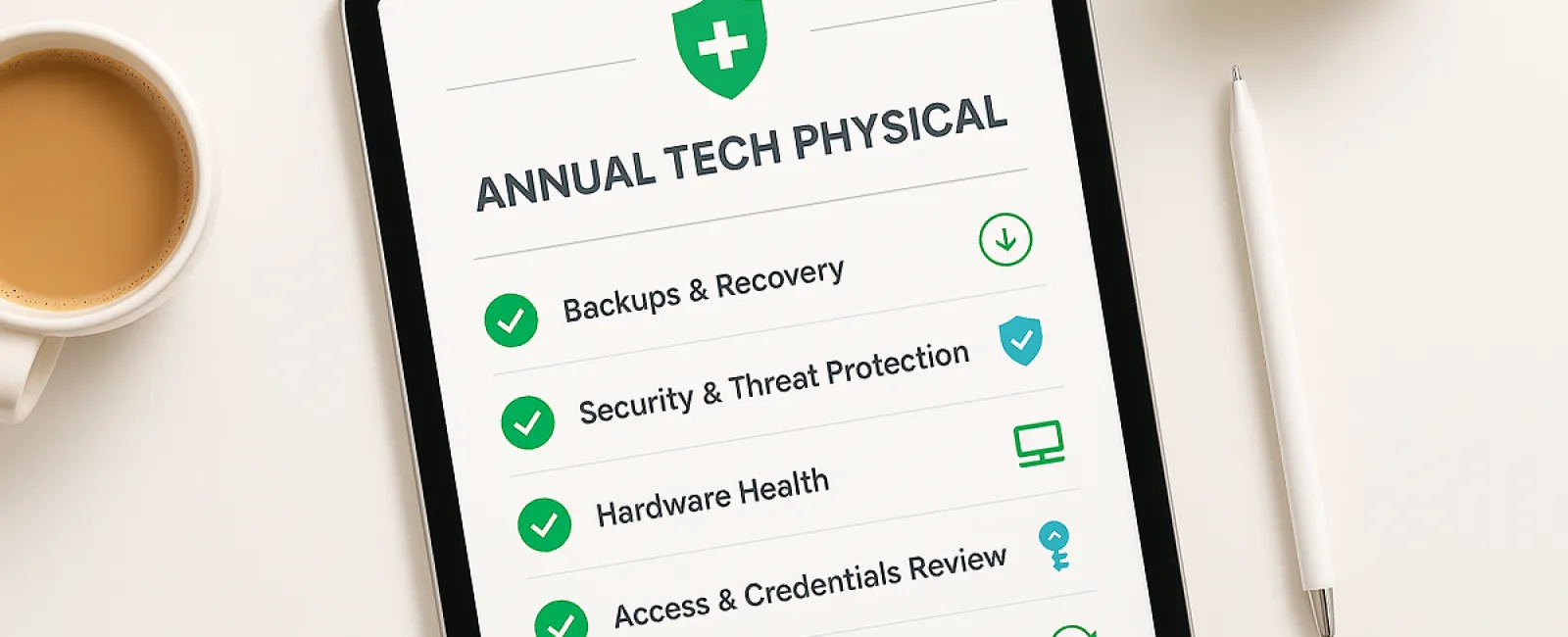
January marks the perfect opportunity to finally tackle those postponed tasks.
Whether it's visiting the doctor, scheduling a dental cleaning, or addressing that mysterious car noise, it's time to act.
While preventive maintenance might seem mundane, it's far less costly than dealing with a preventable disaster.
So, let's confront the crucial question:
When was the last time your business technology received a thorough, professional checkup?
Not a quick fix like "the printer was repaired last week," but a comprehensive health evaluation.
Because functioning and healthy are not the same.
Beware the "I Feel Fine" Illusion
Many avoid medical checkups simply because they feel fine.
Similarly, businesses often postpone tech assessments for reasons such as:
"Everything seems to be running smoothly."
"We're swamped right now."
"We'll address issues when they arise."
The reality is that tech issues rarely announce themselves ahead of time.
Just like silent health conditions—high blood pressure or a hidden cavity—threaten your well-being unnoticed, so do hidden tech vulnerabilities.
Your technology can appear fine until suddenly it becomes an emergency.
The leading causes of tech failures in small businesses usually include:
- Ignoring known risks
- Outdated equipment that seems fine—but isn't
- Backups that exist but fail in restoration tests
- Unmanaged access permissions
- Overlooked compliance issues
Your systems might operate daily yet still be just one unforeseen event away from disaster.
Understanding a Comprehensive Tech Health Check
A professional technology assessment mirrors a medical exam—methodically inspecting your business systems to uncover hidden problems before they escalate.
Key Indicator: Backup and Recovery Systems
This is the lifeblood of your technology's resilience. If other systems fail, can you restore operations quickly?
Consider:
• Are your backups completing fully and successfully?
• When was the last time you tested restoring a file?
• If your server crashed at 9 a.m. on Monday, how soon could you resume work? Do you know the answer?
Many companies only discover backup failures during an incident—it's like realizing your airbags don't function in a crash.
Critical Component: Hardware and Infrastructure
Hardware doesn't politely fail; it wears down over time. Support expires, performance declines, and eventually, failure occurs—often at the worst moments.
- How old are your servers, firewalls, and workstations?
- Are any devices no longer supported by the manufacturer? (No updates, patches, or assistance available)
- Do you replace equipment proactively or wait until it breaks?
Aging technology is a hidden yet major cause of downtime.
Security Check: Access and Credentials
Do you know exactly who has access to your systems? If your answer is uncertain, it's time to update your access controls.
- Can you provide a complete list of current system users?
- Are there former employees or outdated vendors still active?
- Do shared accounts obscure accountability?
Unchecked access expansion—known as access creep—is a common vulnerability, not due to negligence but simply a lack of time to manage it.
Emergency Preparedness: Disaster Readiness
Though uncomfortable, preparing for worst-case scenarios is essential.
- If ransomware struck tomorrow, do you have a clear, practical response plan?
- Is the plan documented and regularly tested?
- How long could your business operate without critical systems?
A vague "we'll figure it out" approach isn't a plan—it's a risk.
Industry Compliance: Specialized Requirements
Your industry defines its own standards for "healthy" technology systems, and these standards are enforced.
- Healthcare organizations must meet HIPAA regulations, where violations can incur steep fines.
- Businesses handling credit cards require PCI compliance, failure of which threatens payment processing.
- Client contracts increasingly demand strict security compliance.
You need expertise that understands your industry's unique challenges—not generic IT advice.
Signs You're Overdue for a Checkup
If this sounds familiar, it's time for a professional evaluation:
"We think our backups are fine."
"Our server is old but still operational."
"Former employees might still have system access."
"Our disaster recovery plan is somewhere…"
"If [name] leaves, it would hurt our operations."
"We'd likely fail an audit if one happened."
The Price of Neglecting Maintenance
A technology checkup requires hours.
Failures cost days, weeks, or even your entire business.
Data Loss: Broken backups combined with hardware failure can mean losing invaluable client records, financial data, and projects—sometimes permanently.
Downtime: Each hour offline means lost revenue, decreased productivity, missed deadlines, and tarnished client trust.
Compliance Penalties: HIPAA violations can lead to fines of up to $50,000 per incident; PCI noncompliance risks payment processing; and state laws impose increasingly strict penalties.
Ransomware Costs: Recovering from attacks now commonly runs into six figures, covering ransom payments, remediation, lost business, and reputational damage.
Choosing prevention is the smart, cost-effective path. Recovery is costly and demoralizing.
Why You Should Rely on Experts
You don't self-diagnose your health by checking your own blood pressure—you seek professionals with the right expertise and tools.
The same principle applies to technology.
You need experts who:
- Understand what a healthy system looks like for your business size and industry—beyond generic best practices.
- Have experience spotting early warning signs based on patterns in organizations like yours.
- See issues you've grown accustomed to, catching risks before they escalate.
This is proactive risk management—fire prevention, not firefighting.
Book Your Annual Technology Checkup Today
With January filled with personal health appointments, add your business technology check to the calendar.
Schedule an Annual Tech Physical.
We'll thoroughly evaluate your systems and deliver a straightforward health report detailing what's working, what's at risk, and what requires attention—well before an emergency strikes.
No tech jargon. No sales pressure. Just clear, actionable insight.
Click here or give us a call at 503-210-5203 to book your Systems Assessment.
Because the best moment to prevent a tech crisis is before it happens. And that moment is now.